


Somewhere in your company, there's probably an AI pilot that never became anything more.
Maybe it's the tool that impressed the room during the demo and never got touched again. Or it's the tool no one trusted, because the data feeding it was never clean enough to rely on.
Every version looks a little different, but the ending is usually the same: a lot of energy spent, and not much to show for it.
If that's where your company is right now, you're not alone.
A failed AI pilot isn't anyone's fault, or even the technology's fault. AI pilots fail because the final step, closing the distance between a pilot that worked once and a habit that runs every day, was never finished.
By the numbers
More companies are stuck at that exact point than you'd guess. Only about 5% of custom AI pilots ever reach production.
But common doesn't make it painless. A shelved AI tool isn't free. You paid for it, your team trained on it, and you told leadership you were doing AI. Then no one brought it up again, and now the story is overdue.
Why AI pilots fail usually comes down to one of a few things, and they all surface at the same point: the move into production.
- The flashy tool that won the demo often can't plug into how the business runs.
- The pilot that worked on clean sample data hits messy company data for the first time in production.
- The pilot with no strategy behind it never had an owner.
Whatever the starting point, that final step is the one that never gets finished. It's also the piece that's easiest to fix, since the harder part, proving AI could work here, already happened. The instinct from here is usually to keep it in-house. The numbers point the other way.
What gets a pilot into production
The pilots that make it are the ones built into the systems your business already runs: your CRM, your finance tools, your operations, and the workflows that tie them together. A pilot that sits off to the side, as its own separate tool, is easy to forget once the excitement wears off.
What that looks like changes case by case.
- Sometimes it's a custom build.
- Sometimes it's fitting AI into a platform your team already opens daily.
The right answer depends on the problem in front of you, not a set playbook.
Tools built specifically for the workflow they're meant to serve, and wired into it, succeeded roughly twice as often as generic tools layered on top. Fit is one factor, who builds it is another, and so is how security gets handled.
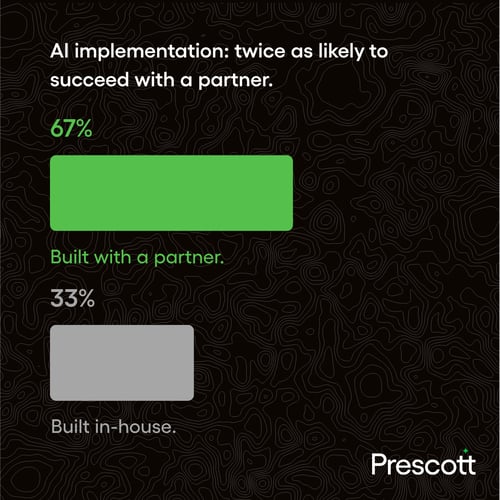 Source: MIT NANDA, "The GenAI Divide: State of AI in Business 2025.
A team that has taken a pilot into production before knows where the friction usually hides, long before it becomes a six-month delay. Security needs that same kind of head start. It's part of the plan from day one, not something added once the project is already moving. And when the same team owns the strategy and the build, nothing gets lost translating one into the other. The decisions made early carry all the way through.
That means you're not stitching together a strategy firm, a developer, and a security consultant on your own, trying to keep three different vendors pointed at the same goal while you're also supposed to be running the business. Prescott makes sure the pieces connect.
The worries that usually come up
A few concerns tend to surface here, and every one of them is fair.
You might not want to rip everything out and start over. You won't have to. Implementation works with the systems you already have. You might also feel like the time and money you already put in was wasted. It wasn't. The work now is building on what's already there.
You might also be worried about coordinating between a strategy firm, a developer, and a security consultant on your own. Having one team carry the whole project removes that problem entirely.
Every month a stalled pilot sits idle, it costs you, in budget and in the story you keep having to tell leadership. But a stalled pilot isn't a dead end. It's proof you were close.
Let's talk about where your AI work stands today, and what it would take to put it into action.

